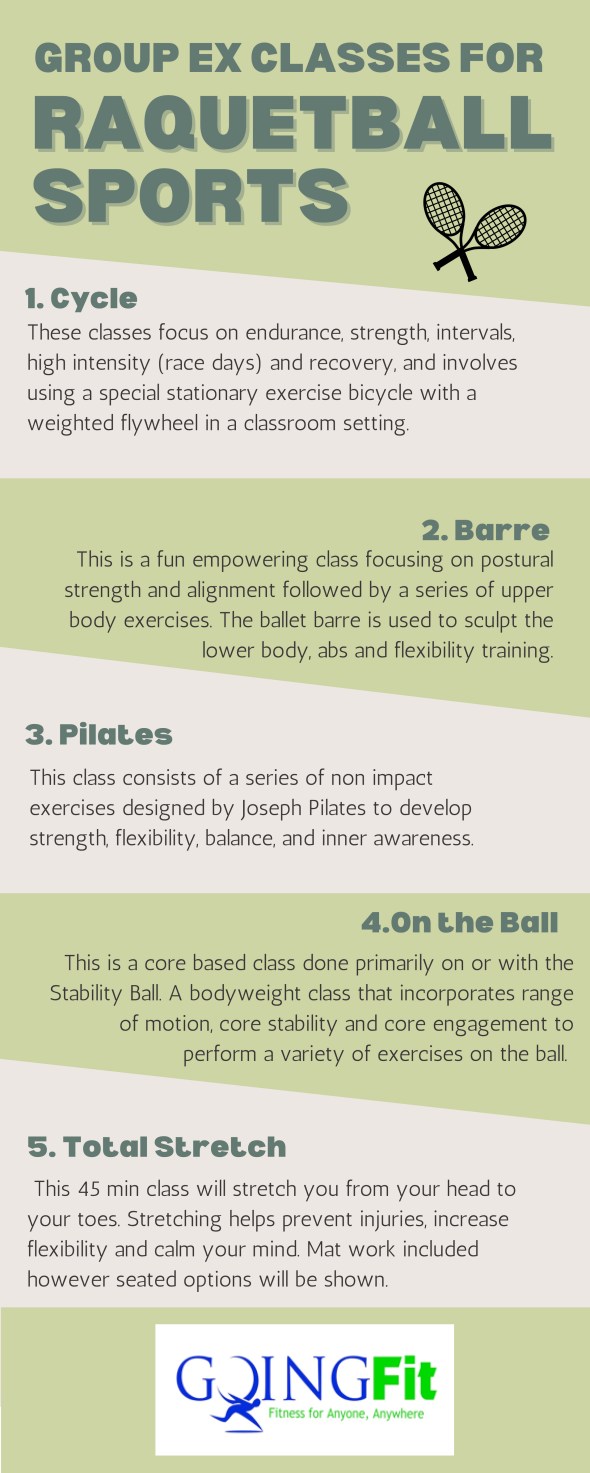
“GOING FIT” – Condition Muscles Prepping for Pickleball

“Going Fit’s group fitness, small group training and personal training all work to increase muscular strength, endurance, cardiovascular endurance, core conditioning, agility, mobility and balance. Try any of our group exercise classes for the drop in rate and then get ready to jump into the monthly membership to get the benefits from Yoga to Cycle. If you are looking for more individualized attention and to focus more on a specific goal, meet with a trainer for your first session and fitness assessment.”


Going Fit, Inc.
Heather Wilson: Haley@GoingFitExercise.com
Tel: 484-947-7315 – Seaside Gym for classes.

TOP 14 ETIQUETTE RULES FOR PICKLEBALL

– rules that you won’t find in any official pickleball tournament handbook or rulebook.

  1. When somebody inadvertently hits a ball onto your court from an adjacent court, retrieve it and toss them that same ball that they hit onto your court. Don’t switch balls. I repeat, don’t switch balls. 
  2. When retrieving a ball from an adjacent court, make eye contact with someone from that court and then directly toss or hit them the ball. Don’t just hit the ball back into their court without looking. That’s very annoying!
  3. If your ball rolls on to the court next to you, shout out, “BALL, BALL ON COURT.” They could be in the heat of battle and did not see the ball, causing an extremely dangerous situation. OR, they just plainly do not see the ball because they are concentrating on THEIR game. Be courteous and let them know YOUR ball is on their court. SAFETY!
  4. Don’t play keep away from the best player on the other team during rec play just so you can win – they want to play too!
  5. Don’t cross the court behind a match until play has stopped. It’s not only rude, but it can be very dangerous as well.
  6. Don’t chest-bump or be excessive in the celebration when your opponent makes an error. If, on the other hand, you or your partner made a great play…Same goes for the “spectators.” Please don’t clap or cheer when the opposing player misses an easy shot.
  7. If you are obviously the weakest player on the court, thank the other players for playing with you after the game. However, don’t take advantage of their graciousness by staying on the court for an indefinite period of time. More than a game or two will undoubtedly wear out your welcome.
  8. If you are asked to play with a group that is obviously of a lower skill level than you, graciously accept and play a game or two with them. They will likely appreciate your graciousness and understand that you want to get back to similarly-skilled players after the game.
  9. If you are obviously the strongest person in your foursome, tone down the competitiveness and hit your opponent’s balls that they can return. Work on a new skill – perhaps it’s a great time for work on that third shot drop shot.
  10. In rec play, don’t exploit someone’s physical limitations just so you can “win.” Not cool!
  11. When somebody inadvertently hits a ball onto your court from an adjacent court, retrieve it and toss them that same ball that they hit onto your court. Don’t switch balls. I repeat, don’t switch balls.
  12. When retrieving a ball from an adjacent court, make eye contact with someone from that court and then directly toss or hit them the ball. Don’t just hit the ball back into their court without looking. That’s very annoying!
  13. Encourage everyone to stay hydrated.
  14. If you and your partner can’t determine if the ball was in or out – or if you disagree with your partner on a line call – the benefit of the doubt goes to your opponent. Wait! That’s actually an “official” rule!

HAVE FUN !!!

Q: Positions during serve- When you are serving, must your partner be behind the back line? Is it a rule? Thanks :)

A: When serving, your partner should be back with you…behind the line, but not required, and it is not a rule, but it is a strategic and wise choice to be back and is a defensive move.

The reason being:
The opponents will almost always want to return the ball deep, they want to keep you deep and they do not want your team (serving team) to get to the net. The main goal is to return the serve deep to keep the serving team at the baseline; power is not as important as control. A short return brings the serving team forward, allowing them to reach the non-volley zone (kitchen) line and negating the receiving team’s advantage. 

The net is where points are won. If your partner is inside the base line (server must be behind the base line). That becomes a target for your opponents. Hit the ball hard and deep to that person (your partner) because your partner will be out of position when the ball is hit at their feet, and the serving team MUST LET THE BALL BOUNCE – definitely compromising your position when accepting the return.

Additionally, you and your partner should always be in concert together. As if you were both holding on to a broomstick. You need to work together, move together forward and back, and left to right. You are forming a wall fighting your opponents.

How to Use the St James Pickleball Website

All of the pages in our website are important. They all contain something that you were looking for, needed the information for, wanted to register for, or it may even answer an argument from the pickleball courts.

On the homepage:

  • Note the navigation toolbar is on every page
  • Our main image changes frequently based on what’s happening
  • Next – We have three featured columns
  • Just under the featured content – One of the most important sections is the “Latest Posts” it contains the most current information from our community and within our website
  • Next to the “Latest Posts” is a list of current Events

Find out more in our short video: How to use StJamespickleball.com website

BONUS!!! Win 3 Pickleballs!

Be on the lookout for an EASTER EGG!
An Easter Egg is hidden code or images placed in the website, on a CD, or in an appliance by the developer. Typically it requires a series of keystrokes or inputting code to reveal an Easter Egg. 

BUT in our circumstance, it will be a hyperlink to a claim form, or it may be a very small picture of an egg that links to a claim form. It is your job to find the link or a picture of the egg, click on either and then fill out the form to claim your 3 FREE PICKLEBALLS.

NOTE: Should someone find the Easter Egg (or link), and claim it, and then should it turn into a mass uncovering of the hidden Easter Egg, the first person find and fill out the form wins. There will be several on the website throughout the year.

Around the Post (ATP)

What an interesting ball return. You’re dinking in the non-volley zone. The ball goes wider and wider, and the next thing you know you are pulled way off the court for an unbelievable get. But instead of returning the ball in a dink fashion back across the net, you are so wide and so low off the court you look up and see an open shot to the rear, baseline section of the opponent’s court. BAM! you just hit your first ATP.

Here are a few things to keep in mind:

11.K.1. A ball contacting the net, the net cable, or rope
between the net posts remains in play.
11.L. The Net.
11.L.1. The net and the wires or strings holding up the net
are positioned (mostly) on the court. Therefore, if the
ball strikes the top of the net or strikes the top net
wire or string and lands inbounds, it remains in play.
11.L.2. If the ball travels between the net and the net post, it
is a fault against the striking player.

Our Opponent Dropped Their Paddle on the Court During Play, Do They Lose the Point?

Thanks for posing this question, which is a very good question and it is always best to discuss these things outside of play.

11.H. Items on the Court. If any item a player is/was wearing or
carrying lands on their side of the court, unless the item
lands in the non-volley zone as a result of a volley, the ball
remains in play even if it hits the item.

But remember, no part of you or anything that has contact with you, including your : hat, paddle, etc., may touch the non-volley zone while in the act of volleying.

9.B. It is a fault if the volleying player or anything that has contact
with the volleying player while in the act of volleying,
touches the non-volley zone. For players using wheelchairs,
the front (smaller) wheels may touch the non-volley zone.
9.B.1. The act of volleying the ball includes the swing, the
follow-through, and the momentum from the action.
9.B.2. If the paddle touches the non-volley zone during the
volley motion, before or after contacting the ball, it is
a fault.

The #1 Move to AVOID in Pickleball

What is the #1 Move to Avoid in Pickleball? This is a great question and of course, there are many good answers, but this was an answer that Scott Hettinger provided.

Do you want to be a better player? Do you want to move from2.5 to 3.0, 3.0 to 3.5, 3.5 to 4.0 or 4.0 to 4.5? Do you want to be a successful doubles pickleball partner?  HERE IS THE NUMBER ONE MOVE TO AVOID…………….

                                                          The Eye Roll

So… your partner popped it up for the 5th time… your partner hammered the ball into the net… again… your partner hits that easy kill shot into the parking lot… etc., etc., etc. We’ve all been there. Resist the urge to give the EYE ROLL. Your partner is doing their best. They didn’t try to pop it up, slam it into the net or crack a windshield in the parking lot. Give them some encouragement. They already feel bad about it. They are doing their best at that moment.  

It certainly isn’t going to improve their play by giving the condescending EYE ROLL or other disparaging moves like mumbling under your breath or dropping your head in disgust.  How about we tell them “No worries you’ll get the next one. That was a tough shot, keep at it you’re doing ok! Good try on that one. You’ll get it.”   Just remember… if you are the best 3.0 and move up to the 3.5 level, you aren’t the best anymore. You are probably starting out at the bottom of that next level.  You might be the one popping it up, hitting the net or the back fence for a while. Do you now want to be on the receiving end of that EYE ROLL? I think not!!!

So, let’s all remember that pickleball is for fun. We aren’t making a living off of it. We are playing with all our friends and neighbors, and we enjoy their company. Don’t lose sight of that fact. Be a better partner. Be a better player. Be a better friend. Just a thought for your day………………….

Scott Hettinger

Every time My Partner Calls the Wrong Score the Opposing Team Says We Must Replay That Point.

Funny how we can’t remember who served, even after we just served. Of course, who can remember the score? But how should we handle it when the opposing team calls the wrong score?

Wrong Score Called (4.K)
The rules concerning what happens if the wrong score is called by
a player or a referee have changed. If a player thinks a wrong
score has been called, a player may stop play to ask for a
correction before the ball is served.

If it has been served, the rally is to be played out and the score correction (if any) is made before the next serve occurs.

My Partner Yelled, “OUT.” The Ball Then Landed In and My Partner Yelled, “No, it’s IN.” The Opposing Team Said You Called It Out.

Well, as confusing as it may be, this happens all the time. Let me read what the rule book states:

6.D.11. While the ball is in the air, if a player yells “out,” “no,”
“bounce it,” or any other words to communicate to
their partner that the ball may be out, it shall be
considered player communication only and not
considered a line call.
6.D.12. An “out” call made after the ball bounces is a line call.
The ball is dead and play shall stop. If, upon appeal,
the referee overrules any type of “out” call, it is a fault
against the player or team that made the “out” call.
Exception: If the match has line judges, the baseline
and sideline judges are responsible for the call. (See
Rule 13.E.2)

NOTE: we also mention this in a previous post from last year, further down in the posts.

New Rules added for 2022: NO Chainsaw serves, NO Swearing!!!

It’s a new year, and that means new pickleball rules. Every January, USA Pickleball issues an updated rulebook. If you cuss during your games, wear headphones, carry more than one ball, or have been using a chainsaw serve, get ready to adjust your play this year. Here are some key things to know about how the game is changing in 2022.

No headphones or earbuds during competition play

These devices have been banned because they could allow players to receive coaching during the match. Another reason for the rule? Player safety — earbuds can be dropped on the court and cause an injury hazard. Also, USA Pickleball says such devices can prevent players from hearing calls or the score, thereby causing potential delays to explain or repeat calls that were not heard. Note: Hearing aids are still allowed.

Spinning the ball on a serve

In 2021, many players experimented with the so-called “chainsaw” serve. In this move, the server rolls the ball against the paddle, sometimes even including the grip, as the ball is being tossed. Then the player hits the fast-spinning ball to finish the serve. The intense spin on the ball can make it kick left, right, up or down.

In 2022, this move has been banned. But you can still put “finger spin” on a serve. The new rules say server can use only one hand to release the ball to perform the serve. If the ball is visibly spun by the server during the release, the part(s) of the hand contacting the ball must be bare (no gloves, band-aids, etc.).

Moreover, the receiver (and referee, if there is one) must be able to see the server’s release of the ball. 

Example: A server is wearing a glove on her hand that releases the ball, but she has removed the glove material allowing the thumb and first two fingers (that touch the ball) to be exposed and add spin to the ball. The referee lets this glove be used.

Extra balls

In officiated matches, you’re not allowed to carry an extra ball on the court. However, in social play, USA Pickleball says you may carry a spare ball. However, the balls are not to be visible to your opponent during play. And if one of your extra balls falls on the playing surface during play, that’s considered a fault.

Example: A player is carrying an extra ball in his pocket. During a rally, the ball falls out of his pocket but lands out of bounds. The opponents claim a distraction fault, but the player who dropped the ball contends that because the ball landed out of bounds and not on the actual court, it is not a fault. The player who dropped the ball is wrong; the opponents are correct that a distraction fault has occurred.

Multiple bounces before a serve

USA Pickleball is clarifying this year that on a serve, there is no restriction how many times the ball can bounce nor where it can bounce on the playing surface before the server hits it. 

The intent of this rule is to let the ball bounce as many times as the server chooses before he strikes the ball to perform the serve, as long as the serve is made within 10 seconds after the score is called. The rule also clarifies that the ball may bounce anywhere on the playing surface before it is hit to perform the serve.

Swearing.

There are a number of new rules about how and when referees can issue warnings for foul language.  

Previously, a referee was allowed to issue one “global warning” per match for use of profanity. When the warning was issued, it was made generally to all players — not just the potty mouths. Now, a referee may give each team a single verbal warning per match. Refs can also give technical warnings and fouls for bad language, which can cost you a point. Refs are not supposed to stop play to issue warnings or fouls, but they are to mete them out once a rally has ended. Check out these examples:

  • Team A receives a verbal warning for uttering an expletive.  Later in the match, a player on Team B   says the same word. The referee may give a verbal warning to Team B regardless of the prior verbal warning issued to Team A.
  • The referee calls a non-volley zone fault on a player who enters the kitchen when he was not permitted to. After the rally is over, the faulted player walks by the referee and without looking directly at the referee says, “That was a bull—- call.”  The referee may issue a verbal warning for unsportsmanlike conduct.
  • Team A gets a verbal warning for a specific profanity. A player on Team B later says the same word, but more loudly. The referee gives a technical warning to Team B. Team B asks why they did not receive a verbal warning the same as Team A. The referee may explain that their volume was greater and verbal and technical warnings are based on referee discretion.
  • A player utters a profanity, and the referee issues a technical warning. The player protests and says the ref should have issued a verbal warning first. The referee reminds the player that there is no requirement that a verbal warning always be issued before a technical warning or technical foul.
  • While players are warming up before the referee’s pre-match briefing, one player loudly calls an opponent an “[expletive] cheater.” The referee issues a technical foul for extreme profanity and issues a point to the opponents before the match has started. 

Easy way to avoid all these warnings and fouls? Don’t swear during games!  If you are looking for ways to re-train your mouth, consider during drills or practice play deducting points for each bon mot uttered. Or, keep a “swear jar” and a roll of coins on the sidelines; deposit a fee for each infraction and your opponent keeps the money. Finally, if you have an Apple Watch or similar device, you can keep track of how many bad words were blurted out during the game by keeping a running tally with Siri. 

To see the full list of new pickleball rules, visit https://tinyurl.com/2af8d7tv. For a complete set of rules, visit https://usapickleball.org/docs/ifp/USA-Pickleball-Rulebook.pdf

Golf’s Growth Has Nothing On Pickleball, But The Two Sports Enjoy Synergies Nationwide (Troon)

Forbes Magazine: 12/30/21

Erik Matuszewski – Contributor – SportsMoney

While golf’s popularity soared across the country over the past year and a half, it was actually the No. 2 participation sport in terms of growth at many country clubs, resorts and golf course communities. 

Tennis has long been a natural complement to golf, but it’s pickleball that’s seen an explosion of adopters in recent years – both in terms of participants and facilities adding courts. While the numbers for 2021 haven’t been released, consider that in 2020 pickleball saw a growth rate in excess of 21%, according to the Sports & Fitness Industry Association’s participation report, jumping from about 3.5 million players in the U.S. to over 4.2 million. That’s still a fraction of the approximately 25 million U.S. on-course golfers, but the growth is substantial and it’s definitely not just a sport for the senior set, with an average participant age of 38.1 years old in addition to an almost a 60-40 split between men and women.

Yale And Other Top U.S. Universities Hit With Lawsuit For Allegedly Price Fixing Student Aid

It was notable that Troon, the world’s largest golf management company, earlier this year partnered with one of pickleball’s leading equipment brands, Selkirk Sport. In golf terms, Selkirk is akin to a PING, a popular, family-owned brand known for their quality products (in this case pickleball paddles) and growing legion of loyal customers. The number of devoted pickleball courts at Troon clubs continues to grow and Selkirk became Troon’s first “preferred pickleball partner” and an official part of the company’s Cliff Drysdale Tennis Division.

“Pickleball has certainly caught people’s attention,” said Troon President and CEO Tim Schantz. “There are clubs with multiple tennis courts that are converting some of that space into pickleball courts and, given the demand for those pickleball courts, they’re thinking about more. There’s something in the game that combines competitiveness for people that like racquet sports, but also the ability to play at a competitive level for a long period of time. That’s kind of the magic of golf too.”

Count Sherri Steinhauer, who played on the LPGA Tour for 26 years and won two major championships, among those who have embraced the golf-pickleball crossover. Steinhauer, now 59, turned to pickleball in 2016 after her golf career was waylaid by hip injuries and today competes professionally in a 50-and-over division while playing almost daily as a resident of Phoenix, Arizona. Visit any golf-centric residential community in states like Arizona, California, North Carolina or Florida and it’s a good bet you’ll hear the sound of a plastic pickleball, which looks a bit like an oversized Wiffle ball, being struck by a paddle. 

“I just fell in love with the sport,” said Steinhauer, who today is a brand ambassador for Selkirk and tried to qualify for nationals earlier this year. “It actually replaced the competitiveness that I felt in golf. But I wasn’t enjoying that in golf anymore. When I played pickleball, I suddenly had that feeling back like when I was a kid and starting out in golf. It’s just gone on from there.”

Steinhauer says there are quite a few LPGA players who play pickleball, among them 29-year-old Amy Olson, who was the runner-up at the 2020 U.S. Open. “We’ve played quite a bit together,” said Steinhauer. “She’s really, really good and fun to play with. And she’s got a group of gals she plays with out on tour.”

Phil Mickelson and Matt Kuchar are among those on the PGA TOUR who play pickleball, a sport that combines elements of tennis with badminton and ping pong. It’s played on courts that are a good bit smaller than tennis courts, which is why a number of clubs, resorts and communities have transformed some existing tennis areas into multiple pickleball courts. Others, like BallenIsles Country Club in Palm Beach Gardens, Florida, have sought to expand their pickleball presence in a meaningful way that complements its outdoor activities.

In addition to its three 18-hole championship golf courses, BallenIsles has been rated as the No. 2 tennis facility in the country and the posh South Florida club has been the home training ground for Venus and Serena Williams for almost two decades. But while the tennis program continues to thrive, BallenIsles added an entire complex of pickleball courts this year to keep up with the growing craze; in just two years since introducing options as part of a strategic plan, the club saw its number of active and interested pickleball participants almost quadruple.

“It’s been on our radar for so long, but this last year has been a real eye-opener on how much our program has grown,” said Gary Henderson, the Director of Tennis at BallenIsles and former world-ranked player who competed at Wimbledon and as a member of Great Britain’s 1995 Davis Cup team. “People can take to the sport with maybe not an advanced skill level in racquet sports and can immediately play again. You can elevate your game very quickly, to a point where you can compete or enjoy a game of social pickleball with people who have played for many years. And the pickleball community, they fit in with each other very well straight away. You’re seeing such growth because of nature of the sport.”

Schantz talked about visiting with the Drysdale team during a Troon teambuilding event earlier in 2021 and getting to play a five-set match against the now 80-year-old Drysdale, the well-known tennis announcer who was once ranked as high as fourth in the world and reached the final of the 1965 U.S. Open tennis championships. While tennis is his central to his lifestyle, Drysdale today plays a good bit of pickleball.

“I was pretty wiped out,” said Schantz. “It was really fun and, much like golf, pickleball has a handicap system in place that lets Cliff and I play against each other and be evenly matched. Although he did beat me.”

Having a golf-focused company like Troon get involved with pickleball is a huge legitimizer for the sport, said Selkirk co-founders Mike and Rob Barnes. When they first got into pickleball in 2014, focusing on research and development as well as marketing efforts, the sport was just starting to take off.

“The amount of people in the sport now is probably one thousand-fold. It’s been crazy to see the adoption,” said Rob Barnes. “Overall, the sport has been growing 10% a year, they estimate, but we think it’s more. Last year during Covid, it doubled. Our company has grown a minimum of 50% to 100% a year since our founding.

Now, with a company like Troon having that foresight for where the sport is going and showing other resorts and management companies the future, that’s huge for the sport. Having them enter is a big legitimizer for the sport and where it’s going.”

The synergies between golf and pickleball are significant – from the demographics to the facilities – and are really helping grow the sport, especially at properties like resorts, country clubs and residential communities.

“The momentum it has right now, we wake up everyday and are blown away where the sport is going and where we think it’s going to be,” said Selkirk’s Mike Barnes. “We don’t see it slowing down anytime soon.”

SJPA October: 1st, 2nd & 3rd – Team Tournament RESULTS

With almost 100 players broken into four teams the competition began. Teams were divided by ratings: 2.5 mixed, 3.0 women, 3.0 men, 3.5 women, 3.5 men, and 4.0 men.

Then the competition began: Men’s and Women’s Round Robin events on Friday, October 1, 2021. Drill competitions all day Saturday, October 2, from 8:30 – 5 pm. The grand finale was dinking competition on Sunday the 3rd and wrapping up the tournament with a mixed round robin event.

We had fantastic weather with warm but pleasant temps. The clubs provided lunch on Saturday. Then on Sunday, after the tournament ended, we enjoyed a celebration dinner and drinks (drinks provided by SJPA). The winners of the three-day tournaments was the Captain Morgan team headed up by Laurie Morgan. The team included: Rosemary Reines, Marge Ferguson, Holly Ahrens, Michelle Volk, Eileen Kuponek, Darin Denzler, Marion Johnson, Susan Lamar, Lisa Daly, Richard Kelly, Bernie Collins, John Summerville, Jim Ahrens, Cynthia Damato, Karen Fania, Lynn Albrecht, Jim Fania, Kevin Daly, Rick Depetris, Tommy Boggs, Joe Beitz.

Round Robin Setup Form

We’ve added a Round Robin Setup form to the SJPA website. The form covers Round Robin play from 8 to 35 players and, as a bonus, a score sheet is located on the last page of the document.

To access the Round Robin Setup form:

  • Hover over “Pickleball Play” at the top of the SJPA website.
  • Scroll down and click on “Round Robin Setup”
  • Print the page or pages that you want to use.

The Sunshine Club

The SJPA is initiating a new group called “The Sunshine Club” whose purpose is to reach out to those members of our pickleball community who are experiencing, illness, surgery, family crisis, etc., and need a little pick me up to show we care.

We would also like to know about any positive news in your lives. Our hope is to reach out to all members of our community with a card or note, to show we care.

The group folks:

  • Marcia Leeds (chair)
    • E: marciaeleeds@gmail.com
    • C: 914 216-3512
  • Cindy Hettinger
    • E: cindyhettinger8@gmail.com
    • C: 570-436-2530
  • Kathy Goliszek
    • E: kfgoliszek@gmail.com
    • C: 336-682-9003
  • Cynthia Mendoza
    • E: csmendo@yahoo.com
    • C: 201 723-4797

Please contact anyone in this group if you know of a situation requiring our group’s participation.

We look forward to hearing from you.